 CyberCode
Web Development
Practical web development articles — data formats, encoding, APIs and the concepts behind everyday dev work.
![Three neon pipelines comparing JavaScript array loops — for and forEach passing [1,2,3,4,5] through unchanged while map transforms it into [2,4,6,8,10]](/_next/image?url=%2Fimages%2Fblog_js_array_loops.png&w=3840&q=75)
2026-08-26
JavaScript Array Loops: for vs forEach vs map
Which JavaScript array loop should you use? A decision table for for, for...of, forEach and map, the async bug forEach causes, and a real benchmark.

2026-07-16
JSON vs YAML: Which Should You Use in 2026?
JSON or YAML in 2026? Compare syntax, comments, speed and tooling — plus the simple rule most teams follow: YAML for humans to edit, JSON for machines.

2026-07-16
camelCase vs snake_case vs kebab-case: Naming Conventions
camelCase, PascalCase, snake_case or kebab-case? See which naming convention each language expects — JavaScript, Python, CSS, URLs — with a reference table.

2026-07-02
What Is Base64 Encoding and When Should You Actually Use It?
Base64 turns binary data into safe, plain text — it is not encryption. Learn how it works, why output is 33% bigger, and the 4 real use cases (plus 2 misuses).
2026-06-29
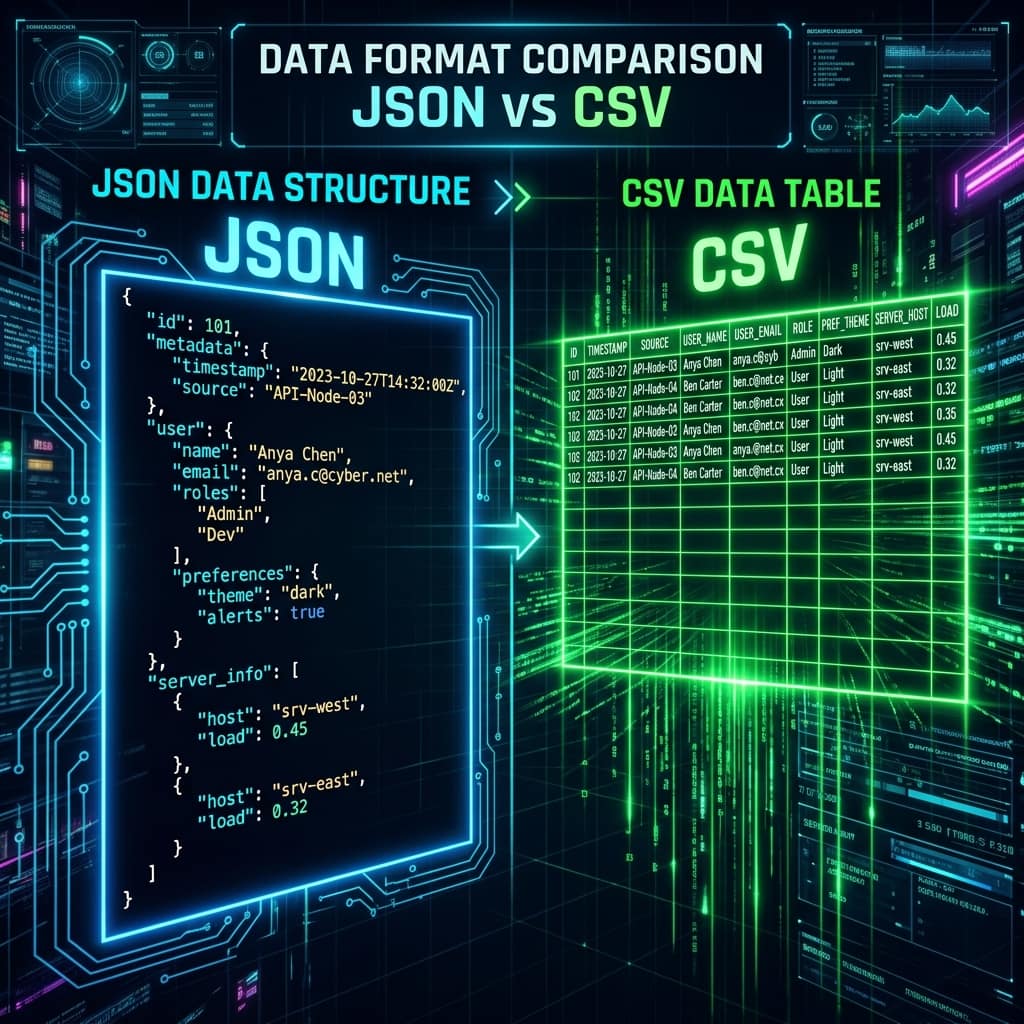
JSON vs CSV: Which Data Format Should You Use?
CSV for flat tables and spreadsheets, JSON for nested data and APIs — a practical comparison with file-size numbers, gotchas, and free converters for both directions.

2026-06-28
Learning to Code in 2026: Where Should a Complete Beginner Start?
HTML, CSS and JavaScript remain the most practical starting point for new programmers in 2026 — here's the reasoning, and a simple 90-day path.

2026-06-26
What Is a UUID and Why Do Developers Use Them Everywhere?
UUIDs are 128-bit IDs that never collide without any central coordination — here's how v4 randomness works, UUID vs auto-increment, and when not to use them.