 CyberCode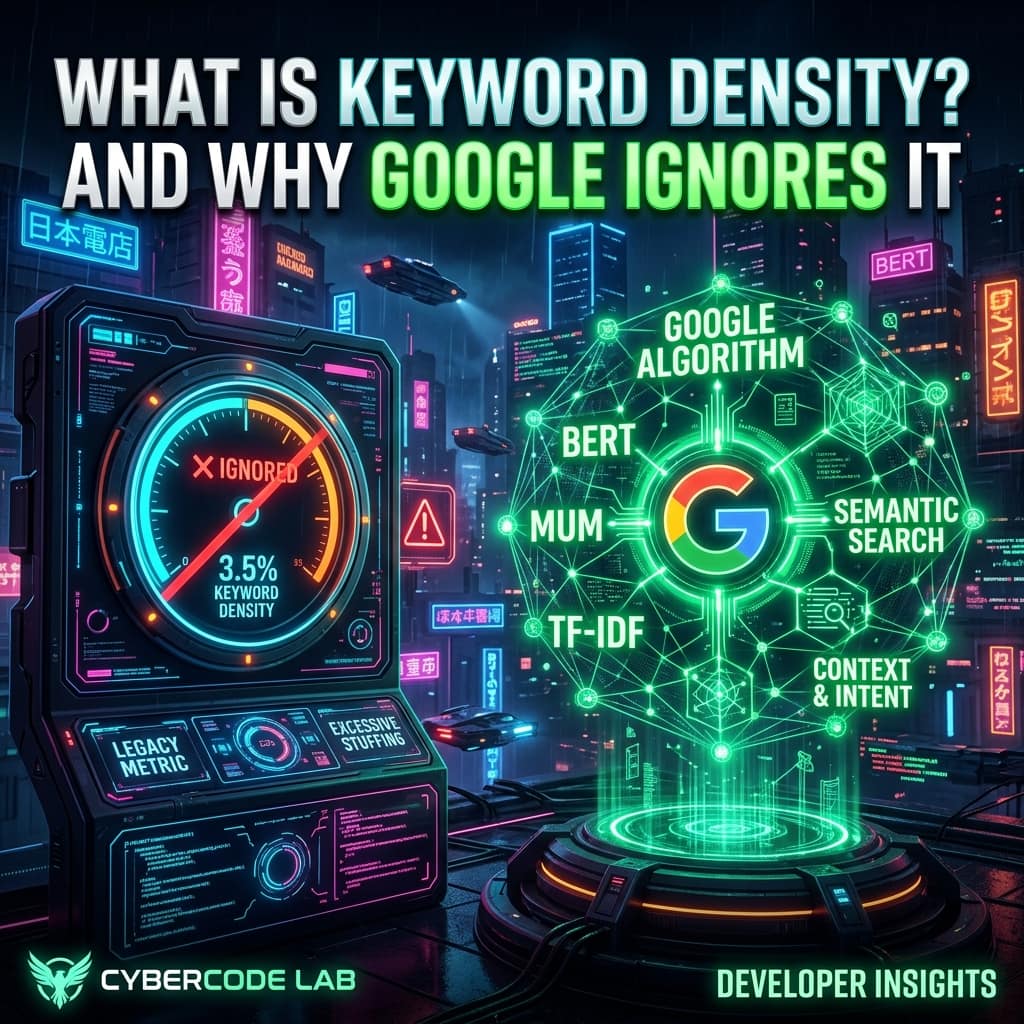
2026-08-30
What Is Keyword Density? And Why Google Ignores It
Keyword density is not a Google ranking factor and there is no ideal percentage. What the number really measures — and the three things it is still useful for.
Keyword density is the percentage of words on a page that are a particular keyword — and it is not a Google ranking factor. Google's Search Advocate John Mueller has said plainly that Google "does not have a notion of optimal keyword density." There is no 1%, no 2%, no magic number to hit. Any tool or article promising you an ideal percentage is selling a rule that Google does not use.
That does not make the number useless — it makes it useful for something other than what most people think. Our free Keyword Density Checker exists for those other reasons, and this guide explains what they are.
How is keyword density calculated?
It's a simple ratio:
keyword density = (keyword count ÷ total words) × 100
So an 800-word article mentioning "keyword density" 12 times has a density of:
(12 ÷ 800) × 100 = 1.5%
That's the whole formula. Note what it does not know: whether those 12 mentions read naturally, whether they're in headings or buried in a footer, whether the article actually answers anything, or whether you also used the obvious variations a real writer would use. It is a word-counting exercise, not a quality measurement.
What does Google actually say about keyword density?
That it isn't something Google measures. Google's Search Advocate John Mueller has addressed this directly and repeatedly:
"No, Google does not have a notion of optimal keyword density." — John Mueller, Google Search Advocate
This is not a recent shift. Google has been publicly playing down keyword density since at least 2006, when Matt Cutts was already steering people away from ratios and towards writing articles readers actually want. Google's own guidance is simply to be explicit — use the words your readers use, so search engines don't have to guess what the page is about.
Two decades of consistent messaging, and the 1-2% rule still circulates. That gap is worth keeping in mind whenever an SEO tool hands you a target.
Why is there no ideal keyword density?
Because the target moves with length, which immediately exposes the idea as arbitrary. Take the widely repeated "aim for 2%" rule:
| Article length | 2% "requires" |
|---|---|
| 500 words | 10 mentions |
| 1,000 words | 20 mentions |
| 2,000 words | 40 mentions |
Same topic, same expertise, same usefulness — but the rule demands four times as many mentions from the longer piece. Nothing about the reader's needs changed. The only thing that changed was the word count, and the rule quietly turned that into a quota.
This is why the advice collapses in practice. Writers who chase the number end up padding sentences with a phrase they'd never repeat naturally, which makes the writing worse for the exact humans the page is meant to serve.
Where did the "1-2%" rule come from?
It was genuinely true once. In the late 1990s and very early 2000s, search engines really did rank pages substantially on how often a term appeared. Repeating a keyword worked, so people repeated it, and "optimal density" advice was born.
Search engines fixed that quickly — it was one of the easiest systems to game. Google has been downplaying keyword density publicly since at least 2006. The rule survived not because it kept working but because it's specific and easy to repeat, which is exactly the kind of advice that outlives its usefulness.
Is keyword stuffing still a problem?
Yes — and this is the part people get backwards. There is no reward for hitting a density number, but there is still a penalty for overdoing it.
Keyword stuffing is a named violation in Google's spam policies: loading a page with keywords to manipulate rankings, including lists of terms without context, blocks of repeated words, or the same phrase forced in so often it reads unnaturally.
So the risk is asymmetric:
- Too few mentions → nothing bad happens; Google works out the topic from context
- Too many mentions → possible spam problem
That asymmetry is the whole practical takeaway. Aim for "natural," and if you must err, err low.
So what is a keyword density checker actually for?
Three genuine uses — none of which involve hitting a target.
1. Catching accidental over-optimization. After editing a page several times, phrases pile up without you noticing. If one term is suddenly at 6-8% while everything else sits near 1%, that's a signal to reread, not a rule you broke. This is the main honest use of the tool.
2. Confirming the page is about what you think it's about. Run a finished article through and look at the top terms with stop words filtered out. If you wrote a guide about time zones and the top terms are "click", "button" and "page", the article drifted. This is a fast sanity check on focus.
3. Auditing a page you didn't write. Taking over someone else's site, or checking a freelancer's draft, a density list tells you in seconds whether the content is naturally written or built around a phrase.
Notice that in all three the number is a diagnostic, not a target. You're looking for surprises, not chasing a percentage.
Why stop-word filtering matters
Run any normal English page through a raw word counter and the top results will be the, and, to, a — typically 4-8% each, far above any real keyword. That's just how English works, and it makes an unfiltered list useless.
Filtering those out is what turns the tool into something readable, which is why our Keyword Density Checker does it by default and reports two-word phrases alongside single words. Phrases are usually the more revealing half — "keyword density" tells you far more about a page's focus than "keyword" on its own.
What should I do instead of counting keywords?
Cover the topic properly, and the keywords take care of themselves:
- Use the words your readers use. Google's own advice is to be explicit rather than making search engines guess — if the page is about time zone conversion, say "time zone" instead of relying on "it" and "this".
- Use natural variations. Real writing about EMIs mentions loans, interest, tenure and instalments. Search engines understand related terms; you don't need to repeat one exact phrase.
- Answer the question early. Being useful in the first paragraph does more for rankings than any distribution of words.
- Write the title and description for humans. Preview how they'll actually appear with our SERP Snippet Preview — see meta titles and descriptions that get clicks for what works.
Frequently asked questions
What is a good keyword density percentage? There isn't one. Google has no notion of an optimal keyword density, so any specific figure — 1%, 2%, 3% — is invented. Write naturally and use a checker to spot accidental repetition rather than to hit a target.
Can low keyword density hurt my rankings? No. Google understands topics through context and related terms, not raw frequency. The one real risk is never mentioning the topic clearly at all — if a page about time zones never actually says "time zone", you've made it needlessly hard to understand. Being explicit is worth doing for readers anyway.
How do I know if I'm keyword stuffing? Read the page aloud. Stuffing is almost always obvious to the ear before it's obvious in a percentage — sentences bend awkwardly to fit a phrase in, or the same term lands three times in a short paragraph. If it sounds strange when spoken, rewrite it.
Does keyword density matter for AI search and AI Overviews? No, and if anything less than before. Systems that summarise content are working from meaning, not term frequency. Clear structure, direct answers and accurate information matter far more than how often a phrase appears.
The honest summary: keyword density is a measurement, not a goal. It tells you what a page repeats — useful for catching mistakes, useless as a target. Check your writing for accidental repetition with the Keyword Density Checker, confirm the length is right for the format with the Word Counter, then go back to writing something worth reading.